
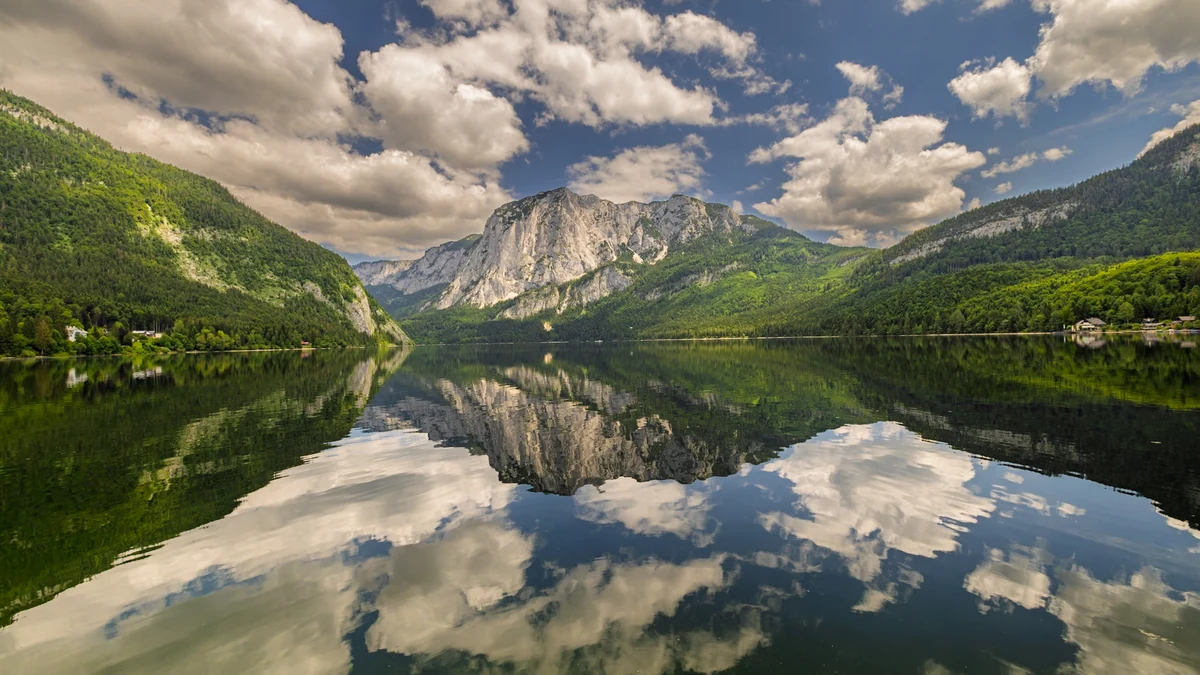
A reflection gives a landscape a second shape. In the photograph above, mountain slopes and broken clouds appear again in the lake, drawing the eye from the skyline down into the water. The lower half is more than empty foreground: it helps hold the composition together.
That makes a useful starting point for your next visit to a lake, pond or quiet stretch of river. Before changing settings, decide what the reflection adds to the picture. These four ideas are about seeing and framing; they are not a reconstruction of the camera settings used for this photograph.
Watch the water before the light
A mirror-like reflection needs a relatively still surface. Wind and small waves break the reflected shapes into fragments. If a clear reflection is your aim, watch for a calm interval instead of assuming every part of the lake will behave the same way.
Distortion can be useful too. Ripples turn a literal mirror into lines and patches of colour. Choose whether you want recognisable detail or a more abstract pattern, then let the water guide the photograph.
Further reading: Adobe — How to master reflection photography
Give the reflection enough room
A central horizon can work well when the subject and its reflection form a balanced pair. It is an option, not a rule. Try another frame with more water, and a third with the reflected scene as the main subject.
Compare the edges as well as the centre. Does the reflected peak have space below it? Is a bright object at the side pulling attention away? A small adjustment at capture can change the balance without needing a tighter crop later.
Further reading: Nikon — Tips for Photographing Mountains
Change your viewpoint deliberately
Try a lower camera position and then a higher one. Notice how the amount of foreground and the visible reflection change. Keep each experiment simple: hold the framing idea in mind and alter one thing at a time.
You do not need to include the entire scene in every photograph. A smaller reflected detail can become a subject of its own. In a wide landscape, check that the real skyline and its reflection both contribute to the picture.
Further reading: Adobe — How to master reflection photography · Nikon — Tips for Photographing Mountains
Return for a different version
The same viewpoint can produce a different photograph as weather and light change. A return visit is an opportunity to compare conditions, rather than repeat the same frame. Calm water may reveal a precise reflection; cloud or mist may simplify the mountain shapes.
Look at the resulting photographs together. Which one makes the relationship between land and water easiest to read? That is a more useful question than whether one image happens to be brighter or more colourful.
Further reading: Nikon — Tips for Photographing Mountains
Editorial notes researched and prepared with AI assistance.
← Back to the blog